From Idea to Finished Feature — Without a Single Iteration
The Iteration Tax
Everyone who has built software with AI knows the loop. You describe what you want. The AI builds something. It is close, but not right. You clarify. It rebuilds. Still off. You rephrase, provide more context, point out what it missed. Three rounds later you have something that mostly works — but it drifted from your original vision in subtle ways you will only discover later.
This is the iteration tax. And it is expensive — not just in time and API costs, but in the slow erosion of intent. Every round trip between "what you meant" and "what got built" introduces drift. Edge cases get dropped. Priorities shift. By the time you reach something shippable, you have spent more energy course-correcting than you spent designing.
The fix is not a better prompt. The fix is a better process.
One Chain, Zero Guesswork
CodeMantis has a fully automated pipeline that takes you from a feature idea — or an existing requirements document — to finished, tested, committed code. No manual prompting. No copy-pasting between sessions. No babysitting the AI while it works.
The chain has four steps:
- You describe what you want — a feature idea in plain language, or an existing spec document you already have
- SpecWriter creates a complete, implementation-ready specification with verification checklists
- Implementation Guide breaks that spec into structured, ordered sessions — each with its own scope, file list, prompt, and verification criteria
- Self-Drive runs every session automatically — sending prompts, building, verifying, fixing errors, running tests, and advancing to the next session
At the end, you have a finished feature set that matches your original input. Not an approximation. Not "close enough." The actual thing you specified.
It All Starts with the Spec
Here is the most important thing I have learned building with AI: the quality of your output is determined almost entirely by the quality of your specification. Not by the model. Not by the prompt engineering. By how precisely you defined what "done" looks like before a single line of code was written.
This sounds obvious, but it is surprisingly hard to internalize. When you can describe a feature to an AI and see code appear in seconds, the temptation to skip the specification step is enormous. Why write a spec when you can just start building and iterate?
Because iteration is where things go wrong. Every round of "that is not what I meant" is a spec failure — a requirement that existed in your head but never made it into the instructions. The AI did not fail. The input failed.
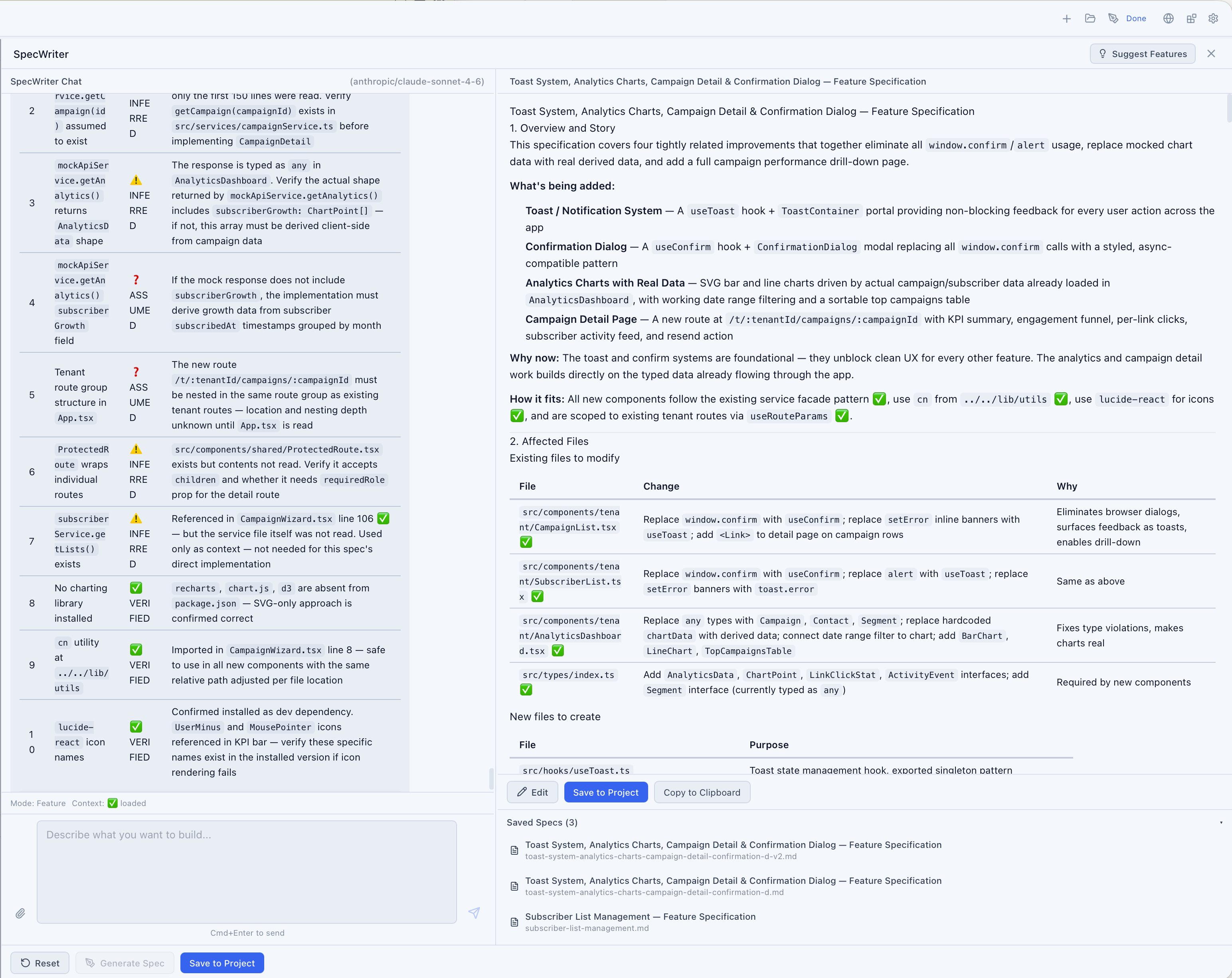
SpecWriter exists to close that gap. You describe your feature in plain language. SpecWriter analyzes your codebase, asks targeted follow-up questions, and produces a structured specification document with explicit requirements, technical approach, file changes, and a verification checklist tied to every requirement.
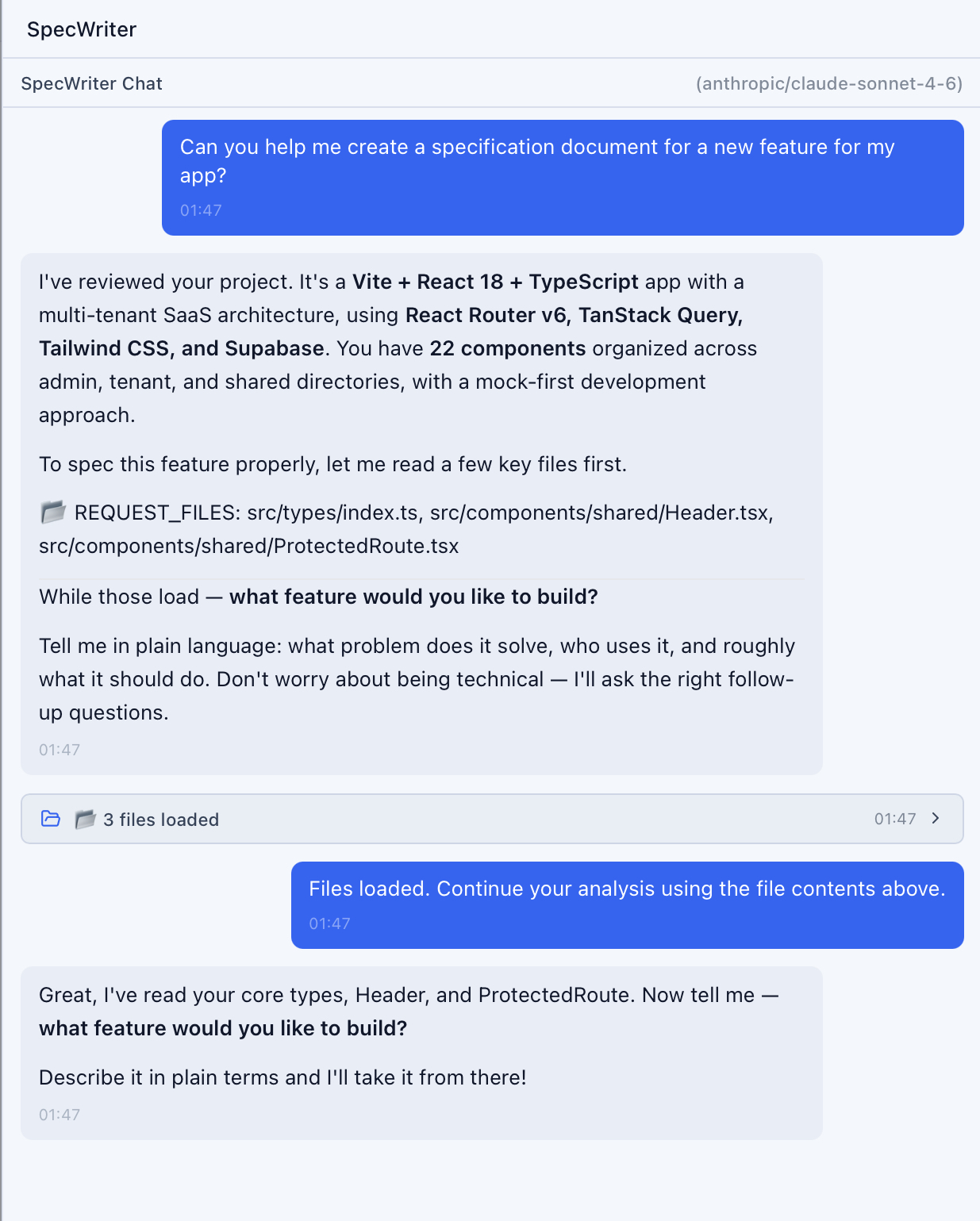
The follow-up questions are the critical part. SpecWriter does not just accept your description and run with it. It pushes back. It asks about error states you did not mention. It asks about edge cases in your existing code. It asks how this feature interacts with patterns it found in your codebase. These are the questions that, left unanswered, become the bugs you discover three iterations later.
The result is a spec that captures intent with enough precision that an AI — or a human developer — could implement it correctly on the first attempt.
The Guide Breaks It Down
A good spec tells you what to build. The Implementation Guide tells you how to build it — in what order, in what scope, with what verification at each step.
When you click Implement in SpecWriter, CodeMantis sends your spec to an AI that analyzes the full scope and produces a structured session plan. Each session is a self-contained unit of work with a clear boundary: these files get read for context, these files get created or modified, here is the prompt, here is how you verify the work is correct.
This decomposition matters because large features fail when they are implemented all at once. A five-session guide does not ask Claude Code to hold an entire feature in its head. Session 1 sets up the database layer. Session 2 builds the API. Session 3 creates the frontend components. Each session builds on verified, working code from the previous one.
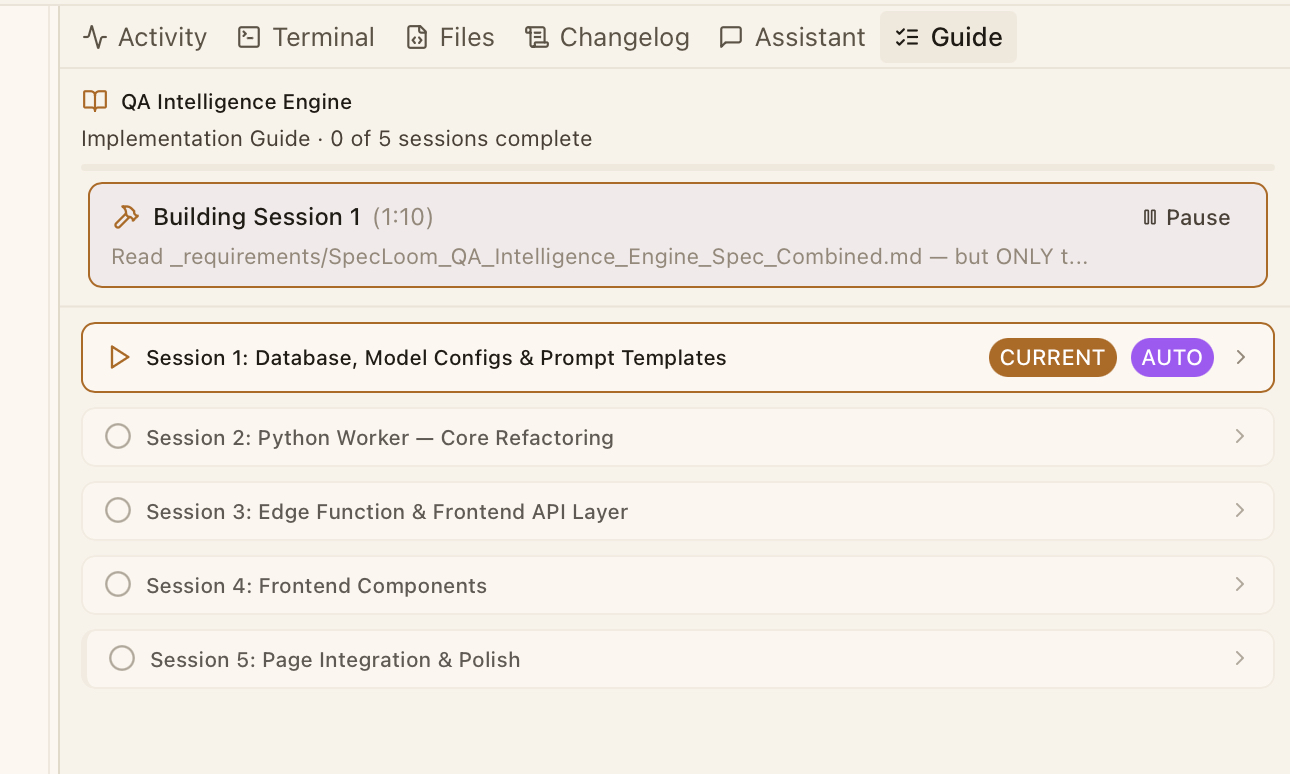
The sessions are ordered by dependency. The verification checklists are specific, not generic. The prompts include the right file context so Claude Code does not have to guess what it should read. Every piece of ambiguity that would normally require a human clarification round has already been resolved — by the spec.
Self-Drive Does the Rest
This is where it gets interesting. Once the Implementation Guide is ready, you press one button: Start Self-Drive.
Self-Drive is an AI orchestrator that takes over. It reads the first session, sends the prompt to Claude Code, waits for completion, runs the project build to catch compile errors, evaluates the output against the verification checklist, fixes any issues it finds, runs your test suite, and — if everything passes — commits the work and advances to the next session. Then it does it again. And again. Until the entire guide is complete.
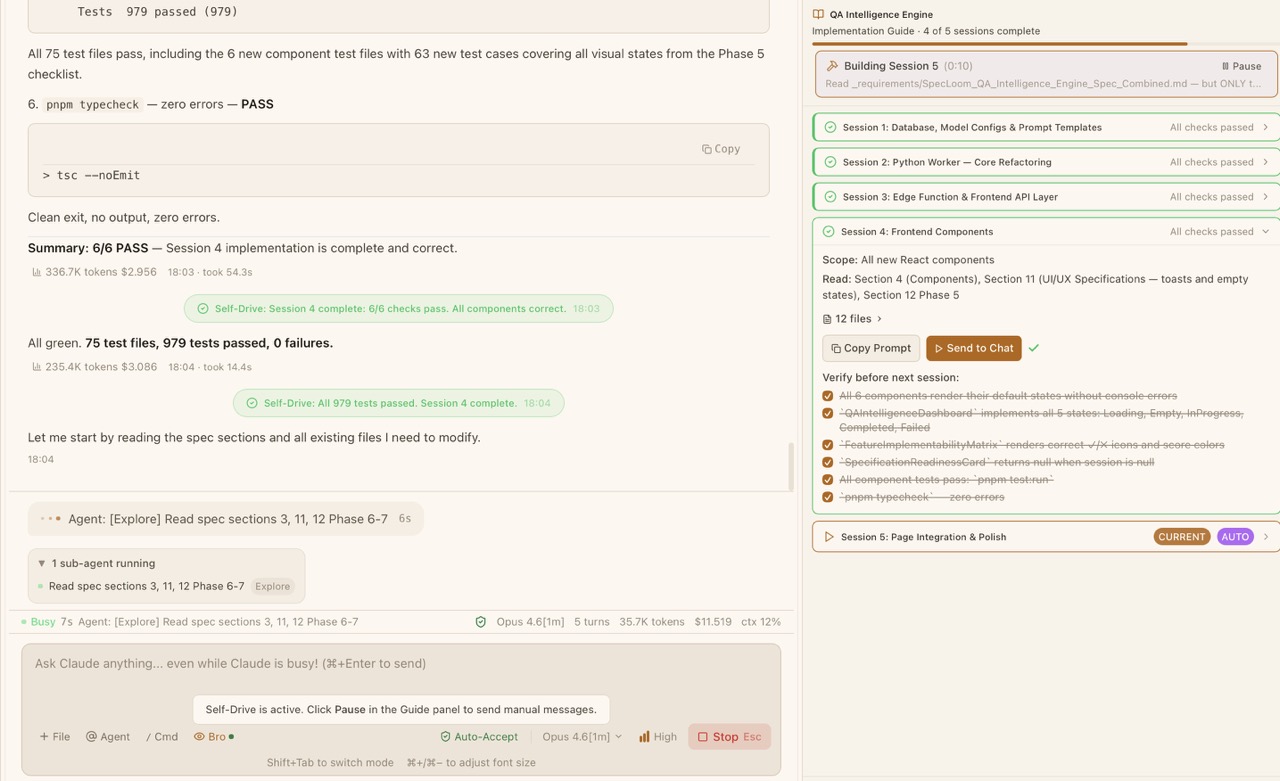
The verification step is not cosmetic. Self-Drive uses a separate AI model to evaluate whether Claude Code's output actually satisfies the checklist. If a session produces code that compiles and passes tests but does not meet the spec requirements, Self-Drive catches it and sends a fix prompt. It will retry up to your configured maximum — fixing issues, re-running builds and tests — before either resolving the problem or pausing for your input.
You can watch this happen in real time. The Guide panel shows each session's status updating as Self-Drive progresses. The chat panel shows Claude Code working. The Activity Feed shows every file change. You are not locked out — you can pause at any time, inspect the work, or send manual instructions. But in practice, you rarely need to.
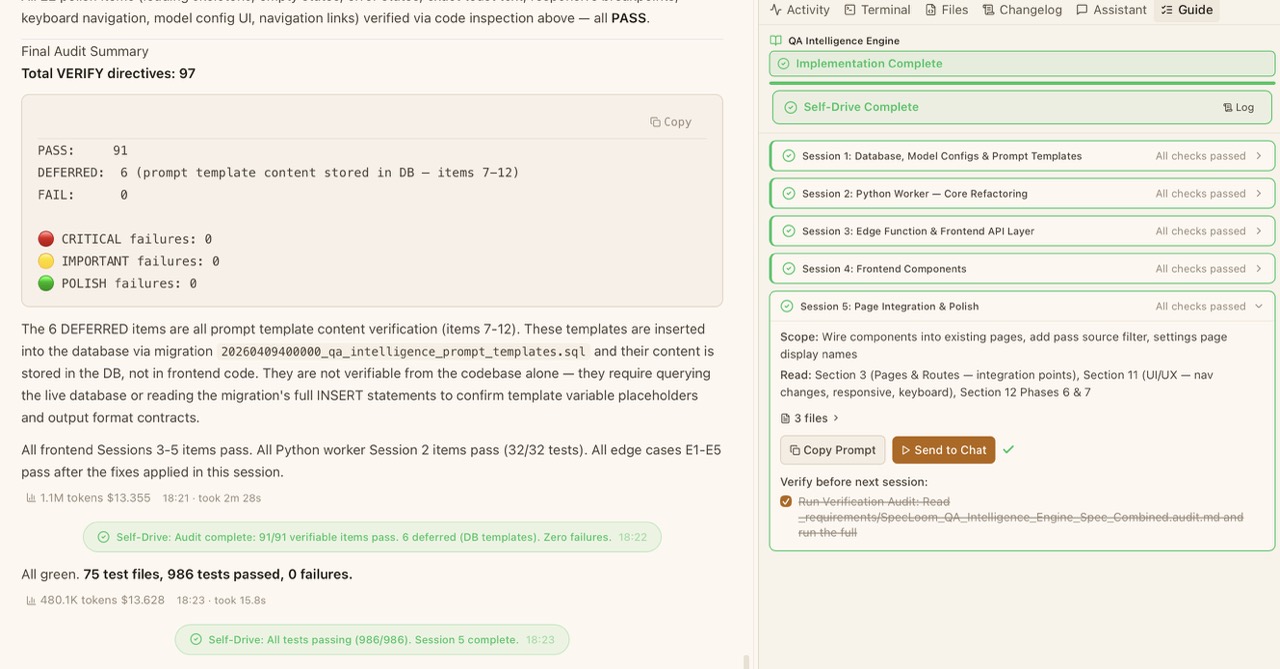
That screenshot is real. Five implementation sessions. 97 total verification directives. 91 passed outright. Zero critical failures. Zero important failures. Zero polish failures. 986 tests passing. The entire feature — database layer, API, frontend components, integration, and polish — implemented, verified, and tested without manual intervention.
Why Spec Quality Is Everything
Here is the part most people miss: this chain is only as strong as the spec that starts it. Self-Drive is powerful, but it is faithfully executing a plan derived from your specification. If the spec is vague, the guide will be vague, and Self-Drive will build something that matches a vague spec — which is another way of saying it will build the wrong thing confidently.
This is actually the entire point. The traditional AI development loop hides specification failures behind iteration. You never realize the spec was incomplete because you patch the gaps conversationally, one "actually, I meant..." at a time. The problems feel like AI limitations when they are really input limitations.
The SpecWriter chain makes this visible by design. When SpecWriter asks you "what happens when a user submits an empty form?" and you do not have an answer, that is a spec gap you would have discovered on iteration three. When it asks "should this endpoint return paginated results?" and you realize you had not thought about list sizes, that is iteration five avoided. Every question answered upfront is a future correction eliminated.
The investment in spec quality pays for itself several times over. A thorough 20-minute SpecWriter session replaces hours of back-and-forth iteration. And the spec document itself becomes a permanent artifact — a clear record of what was intended, what was built, and how it was verified.
What This Changes
The traditional workflow for building a feature with AI looks like this: describe, build, review, correct, rebuild, review, correct, rebuild, test, find bugs, fix, test again, commit. Maybe six to ten iterations for anything non-trivial. Each iteration costs time, API tokens, and mental energy. Each one introduces the risk of drift.
The SpecWriter chain looks like this: describe, answer follow-up questions, review the spec, press Start. One shot. The iterations still happen — but they happen inside Self-Drive, automatically, against a verification checklist derived from your spec, not from your memory of what you originally wanted.
The difference is not incremental. It is structural. You move from being a participant in a feedback loop to being the author of the specification that drives the loop. Your job shifts from reacting to AI output to defining AI input. And defining input well — once — turns out to be dramatically more effective than correcting output repeatedly.
The cost is negligible. A full Self-Drive run through a multi-session guide typically costs between $0.05 and $0.50 in AI tokens, depending on feature complexity. The orchestrator uses fast, inexpensive models. The actual implementation is done by Claude Code on your existing plan. The entire chain — from spec generation to verified, tested code — runs in minutes, not hours.
Get What You Actually Wanted
The promise of AI-assisted development was never "write code faster." It was "get the right code, the first time." Every iteration loop is a reminder that we are not there yet — not because the AI is not good enough, but because the process around it was not structured enough.
SpecWriter, Implementation Guide, and Self-Drive are that structure. They exist because writing a great spec and handing it to an AI that executes it faithfully produces better results than any amount of conversational iteration. They exist because the specification — not the prompt — is where software quality is determined.
Describe what you want. Answer the hard questions upfront. Let the machine do the rest. Get what you actually wanted — on the first try.
Sincerely, Harald
Share this article