Why CodeMantis Now Supports Two Coding Agents (and Soon More)
The Day the Rules Changed
On June 15, 2026, Anthropic restructured Claude subscription billing. The change is published on the official Claude Code Legal and Compliance page, and the policy reads, verbatim:
“Starting June 15, 2026, Agent SDK and claude -pusage on subscription plans will draw from a new monthly Agent SDK credit, separate from your interactive usage limits.”The new pool is $20 / $100 / $200 per month for Pro / Max 5x / Max 20x respectively, metered at full API rates, with no rollover. Interactive use — Claude.ai web/desktop/mobile, Claude Code in the terminal, Claude Cowork — stays on the original subscription, unchanged.
Anthropic is allowed to price their product however they want, and a split between interactive and programmatic billing is a defensible way to scope subscription value. But for anyone whose workflow leaned on claude -pautomation — CI checks, batch jobs, headless agents — “cost just changed” is not an abstract concern. It is the kind of memo that turns a working workflow into an unexpected bill.
Why This Affects a Mac App That Wraps the CLI
CodeMantis launches your own claudebinary on your own machine, exactly as Anthropic's policy describes “ordinary use of Claude Code and other native Anthropic applications.” That is the explicitly-permitted lane. The interactive main-chat experience is unaffected by the June 15 change.
But CodeMantis does more than relay your typing. Self-Drive runs verification passes between sessions. Implementation Guide orchestrates multi-session work. Preflight probes capabilities. Some of that work, depending on how the CLI evolves, can drift into the -p lane — which now bills against the separate Agent SDK credit pool at full API rates. Even if today nothing in CodeMantis crosses that line, future policy tightening could move the line under us. We needed optionality.
The Fix Was Already in the Codebase
In v1.2.0 we did a quiet refactor: the entire Claude path moved through an AgentAdaptertrait. At the time it was a clean-code play — the streaming protocol, the session lifecycle, the tool-approval flow all converged on a single interface so the UI didn't have to know which agent it was talking to.
It turned out to be the seatbelt we didn't know we'd need. When Anthropic announced the June 15 change, adding OpenAI Codexas a second agent took a single release. v1.3.0 shipped with Codex as a first-class option: same chat panel, same activity feed, same SpecWriter, same Self-Drive, same project picker. The adapter handled the protocol differences; the UI mostly didn't notice.
What Codex Brings
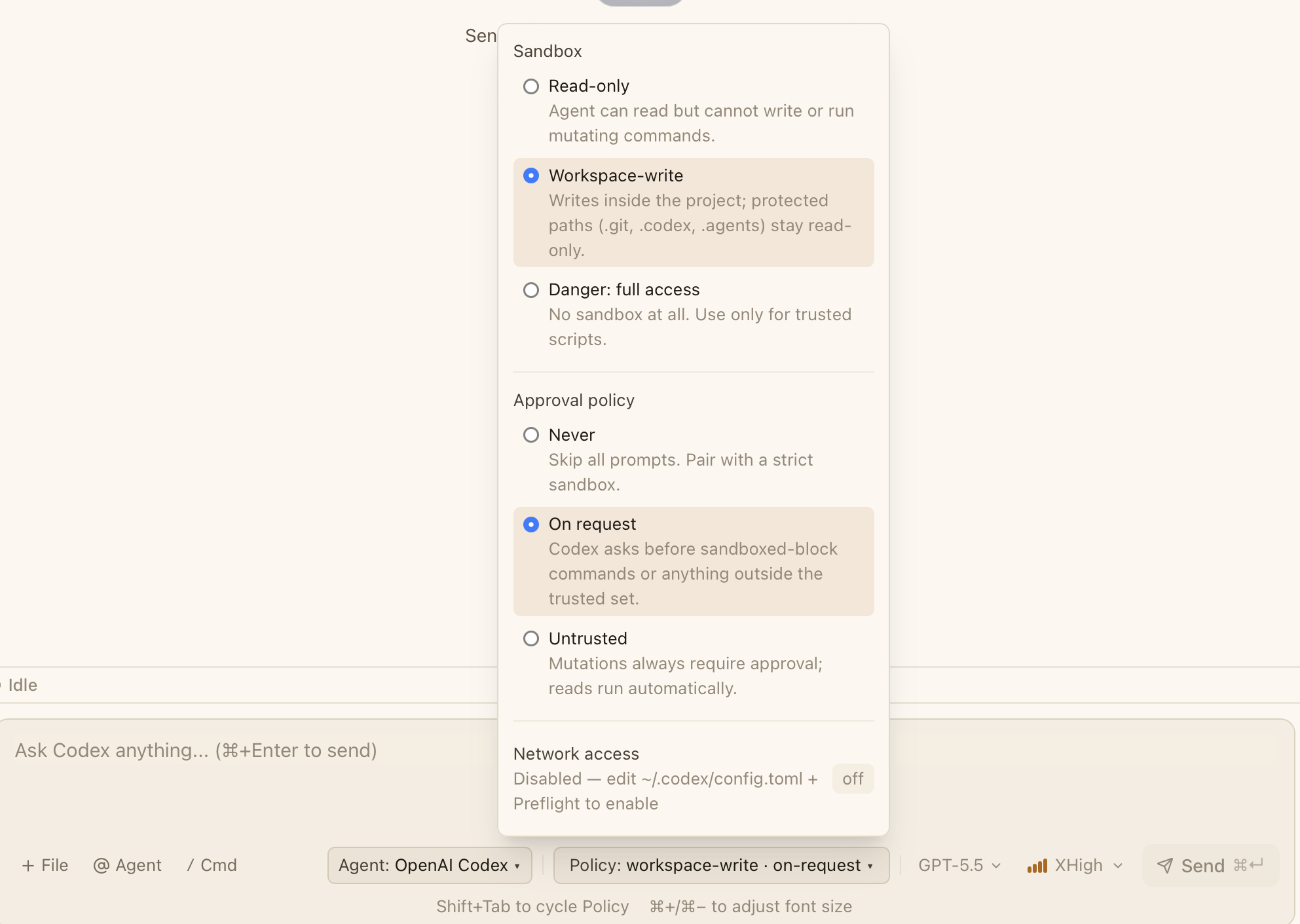
Codex authenticates against your existing ChatGPT Plus, Pro, or Businesssubscription via OAuth — no separate OpenAI API key required. Strong tool use, strong codegen, and a sandbox-and-approval-policy model that's architecturally different from Claude's session-mode model. Rather than force one to look like the other, CodeMantis surfaces Codex's native model as a Codex Policy Pill in the input toolbar — sandbox (read-only, workspace-write, danger) and approval policy (untrusted, on-request, on-failure, never) are two independent dials, set per session.
On the Welcome Screen, CodeMantis checks for at least one agent — either is enough, both is better. If both claude and codex are installed, the Project Picker grows an Agent Picker so you can choose per project. Sessions carry an agent_id. The chat panel knows. The activity feed knows. You don't have to.
Per-Task Routing — the Real v1.5.0 Unlock
v1.5.0 added the change I'm most excited about: per-task agent routing. In Settings › Agents, when both CLIs are installed and signed in, you get a small table mapping task categories to agents:
- main_chat — the agent your main project sessions default to
- spec_writer — the agent SpecWriter hands off to when you click Implement
- assistant — the agent powering local-CLI assistant tabs
- help — the agent powering the in-app Help assistant
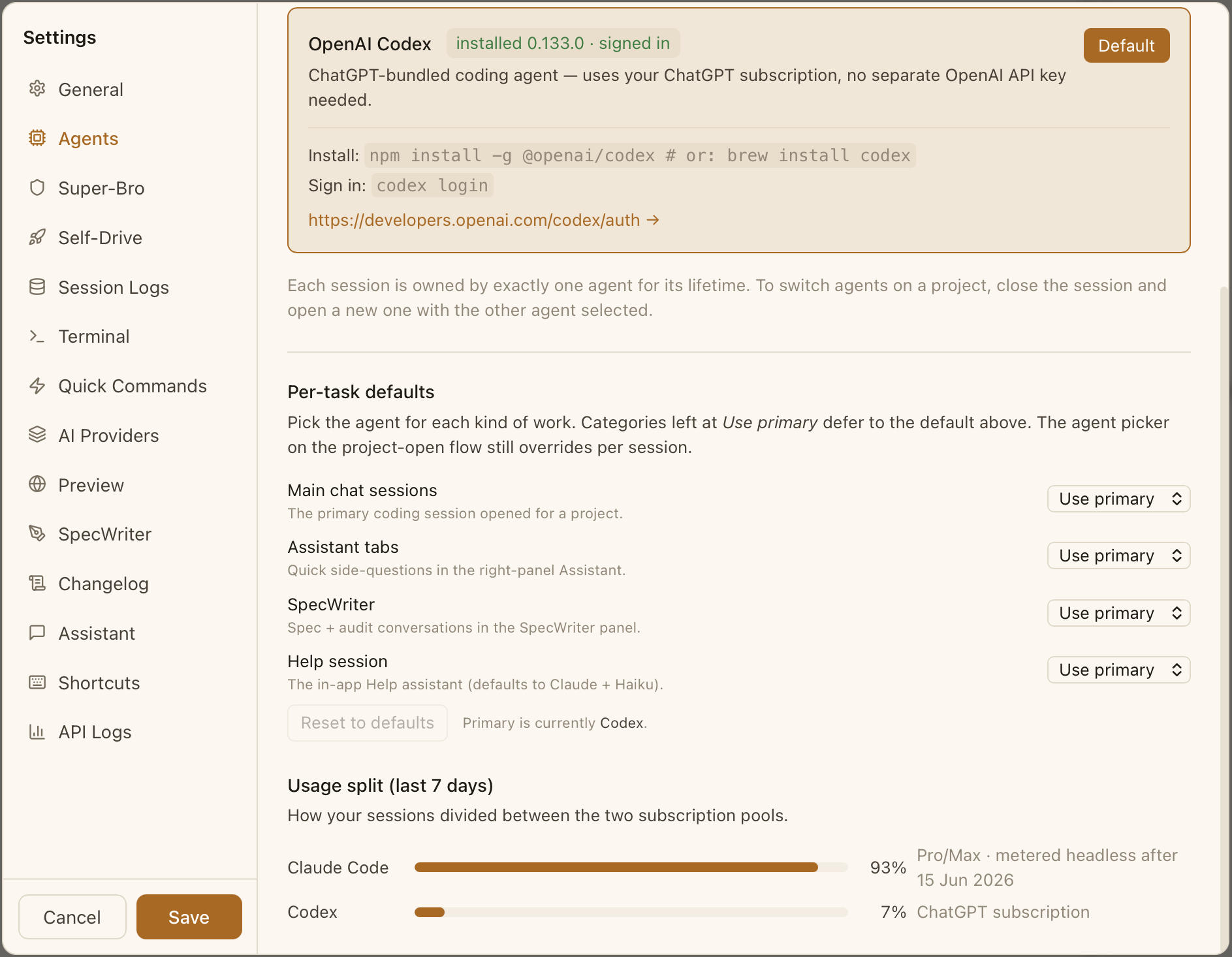
A worked example: route spec_writerto Claude (it's strong at long-form spec reasoning), main chat to Codex (cheaper subscription headroom for hot iterations), and leave Help and Assistant on “Use primary” so they follow whichever agent you've made the default. The same tab shows a 7-day usage-split card — per-agent token counts and an estimated-cost breakdown — so you can see where your subscription pool actually goes and rebalance.
What Self-Drive Does Not Do
Self-Drive is not a per-task category. It always inherits the agent of the session it attaches to. If your main chat is routed to Codex, Self-Drive runs on Codex too.
That's deliberate. Self-Drive's evidence vocabulary — how it parses an agent's verification replies, how it decides when to retry, when to mark a verification as N/A under capability gating — is calibrated per agent. Mixing agents inside a single autonomous run would mean reasoning across two different verification grammars. Cleaner to fix the agent at session start and let the orchestrator stay consistent for the whole run.
What's Next — Agents Are Pluggable
The principle behind all of this: CodeMantis is the interface, not the agent. You bring the agent you already pay for. We bring the chat panel, the activity feed, the SpecWriter, the project templates, the Self-Drive orchestrator, the preview browser, the file viewer, the terminal. Your habits, your sessions, your project context — none of that should have to migrate when the agent landscape shifts.
The AgentAdaptertrait that made Codex easy is the same trait that will make the next agent easy. Whatever ships next — a new Google Gemini coding CLI, an open-source agent, something we haven't seen yet — slots in as a config and a couple of adapter methods, not a rewrite. The Project Picker grows another option. The per-task table grows another column. Your existing sessions keep working.
The Promise
CodeMantis's promise isn't “we picked the right agent for you.” That answer changes every few months. The promise is “we picked an architecture that can't be broken by anyone else's pricing memo.”
Anthropic is one of the best-run AI companies in the world, and Claude Code remains one of the most capable coding agents in existence. None of that is in doubt. But the right number of coding agents to support, in a free fair-source Mac app meant to outlast vendor policy cycles, was never one. It is at least two. And tomorrow it will be more.
Sincerely, Harald
Sources & further reading
- Anthropic · Claude Code — Legal and Compliance (June 15, 2026 notice)
- Anthropic Support · Use the Claude Agent SDK with your Claude plan
- CodeMantis · Choosing your coding agent (Claude Code vs. Codex)
- CodeMantis · Per-task agent routing (v1.5.0)
Share this article